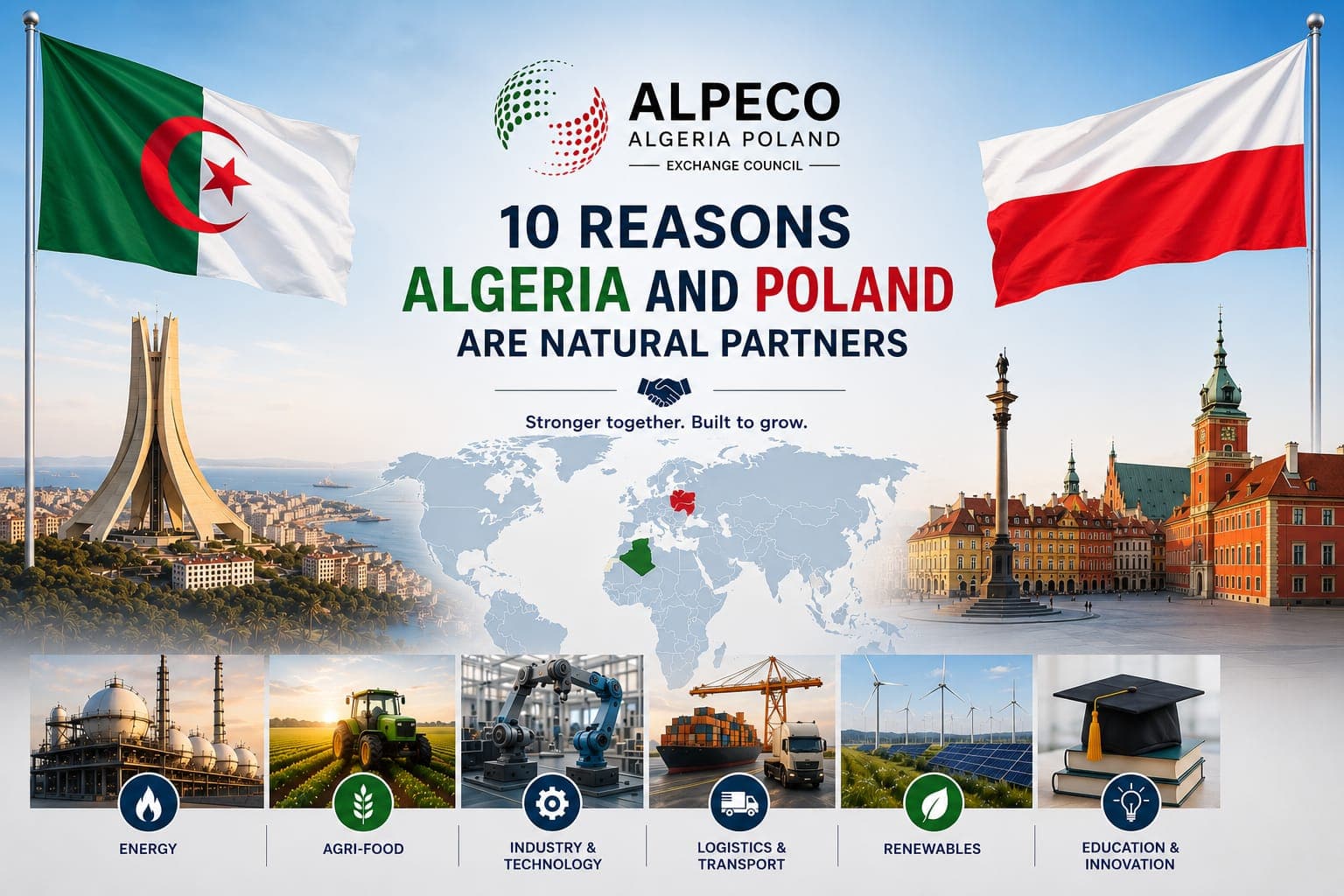
10 Reasons Algeria and Poland Are Natural Partners
From energy and agri-food to EU market access and shared history, 10 reasons Algeria and Poland's economic relationship is built to grow.
10 Reasons Algeria and Poland Are Natural Economic Partners
Algeria and Poland are, on paper, an unlikely pairing: one a North African economy built on hydrocarbons and a young, fast-growing population, the other a Central European EU member with a manufacturing and agri-food base shaped by three decades of post-1989 transformation. Yet over the past two years, and especially in 2026, the relationship between the two countries has accelerated noticeably, marked by high-level visits, new cooperation agreements, and a growing list of sectors under active discussion. Here are ten reasons this partnership makes sense, and why it appears to have real momentum behind it.
1. A Trade Relationship That Has Already Reached USD 1 Billion
Bilateral trade between Algeria and Poland reached approximately USD 1 billion in 2025, according to Polish officials, with Algerian exports to Poland reportedly doubling to around USD 300 million over the same period. Agri-food, led by Polish exports of skimmed milk powder, has been the traditional backbone of this relationship, but the recent growth on both sides suggests a trade relationship that is broadening, not just deepening along familiar lines.
2. Energy and Petrochemical Complementarity
Algeria is one of Europe's most significant natural gas suppliers, while Poland's fertiliser and chemical sector, led by Grupa Azoty, relies on gas as a feedstock. In April and May 2026, Algerian and Polish officials, alongside Sonatrach, Grupa Azoty, and Orlen, held a series of talks on cooperation across fertilisers, methanol and melamine production, phosphoric acid, and green ammonia. As one senior Polish diplomat put it during the visit, “Algeria produces it [gas]; we need it and we are able to use it for fertiliser production.” This is complementarity in its most literal sense.
3. Algeria's Reformed Investment Framework Lowers the Barrier to Entry
Algeria's 2022 Investment Law removed the blanket requirement for majority Algerian ownership across most sectors, and the AAPI one-stop shop system, now moving toward full digitalisation, is designed to simplify registration for foreign investors. For Polish companies, this means the regulatory starting point in Algeria today, full ownership in most sectors, a single registration agency, and structured incentives, is considerably more favourable than it would have been even a few years ago.
4. Poland Offers Algerian Exporters a Cost-Effective Route Into the EU
Algerian goods already benefit from largely duty-free access to the EU under the 2002/2005 EU-Algeria Association Agreement. Poland's central European location, competitive logistics costs, and access to both Western and Central/Eastern European markets make it a practical base for Algerian companies looking to use that access more effectively, complementing the more familiar route through Western Europe.
5. Algeria's Food Security Drive Matches Poland's Agricultural Strengths
Algeria has set ambitious 2026 targets around durum wheat self-sufficiency, and its 2026 agricultural budget increase is directed toward irrigation efficiency, mechanisation, seed systems, and food processing. These are precisely the areas where Polish agri-tech companies, in precision agriculture, GPS-guided machinery, and agricultural equipment manufacturing, alongside Poland's broader strength as one of the EU's largest agri-food producers, have real and demonstrated expertise.
6. Water Management and Desalination: An Emerging Frontier
During the April 2026 energy and industrial talks between Algeria's Energy Minister and Poland's Deputy Minister of State Assets, water desalination was specifically identified as a potential area of cooperation, with Algeria expressing interest in Polish technological solutions to improve efficiency as it expands its desalination capacity. This is a relatively new addition to the cooperation agenda, but one that fits squarely within Algeria's broader water-security challenges and Poland's growing expertise in efficient water and irrigation technologies.
7. A Relationship With Deep Roots, Dating to 1962
Algeria and Poland established diplomatic relations in 1962, the year of Algerian independence, and officials on both sides have repeatedly described the relationship in terms of long-standing friendship. This is not simply diplomatic language: it reflects a relationship that predates the current wave of economic interest by more than six decades, giving the partnership a foundation that purely transactional relationships often lack.
8. Poland's Post-1989 Transformation Is a Relevant Model
Algeria's current economic strategy centres on diversification, import substitution, and building domestic production capacity, priorities embedded directly in its 2022 Investment Law. Poland's transformation since 1989, from a centrally planned economy to one of the EU's most competitive economies, including in agri-food, manufacturing, and technology, offers a relatively recent example of exactly this kind of transition, achieved within living memory by a country that started from a broadly comparable need to modernise quickly.
9. Unprecedented Political Momentum in 2026
In April 2026, Poland's Deputy Prime Minister and Foreign Minister made the first visit by a Polish foreign minister to Algeria since 2017, accompanied by senior representatives from Grupa Azoty and Orlen. The visit produced a cooperation agreement between the Polish Diplomatic Academy and Algeria's Institute of Diplomacy and International Relations, agreements to organise trade missions, cultural initiatives, and academic exchanges, and a series of follow-up ministerial talks on energy and industry within weeks. As Poland's top diplomat put it during the visit, “Poland and Algeria are rediscovering each other.”
10. Growing People-to-People Ties, and a Market That Remains Largely Untapped
Academic exchange between Algeria and Poland is growing, from a rising number of Algerian students choosing Polish universities to scientific cooperation between institutions such as the University of Economics in Katowice and Algeria's Research Center for Applied Economics for Development (CREAD). At the same time, Poland barely registers among the leading foreign investor countries in Algeria today, behind the United States, Italy, France, Spain, and the United Kingdom. Combined with the nine points above, this points to a relationship with substantial room to grow, and to genuine first-mover advantages for the companies and institutions willing to engage now.