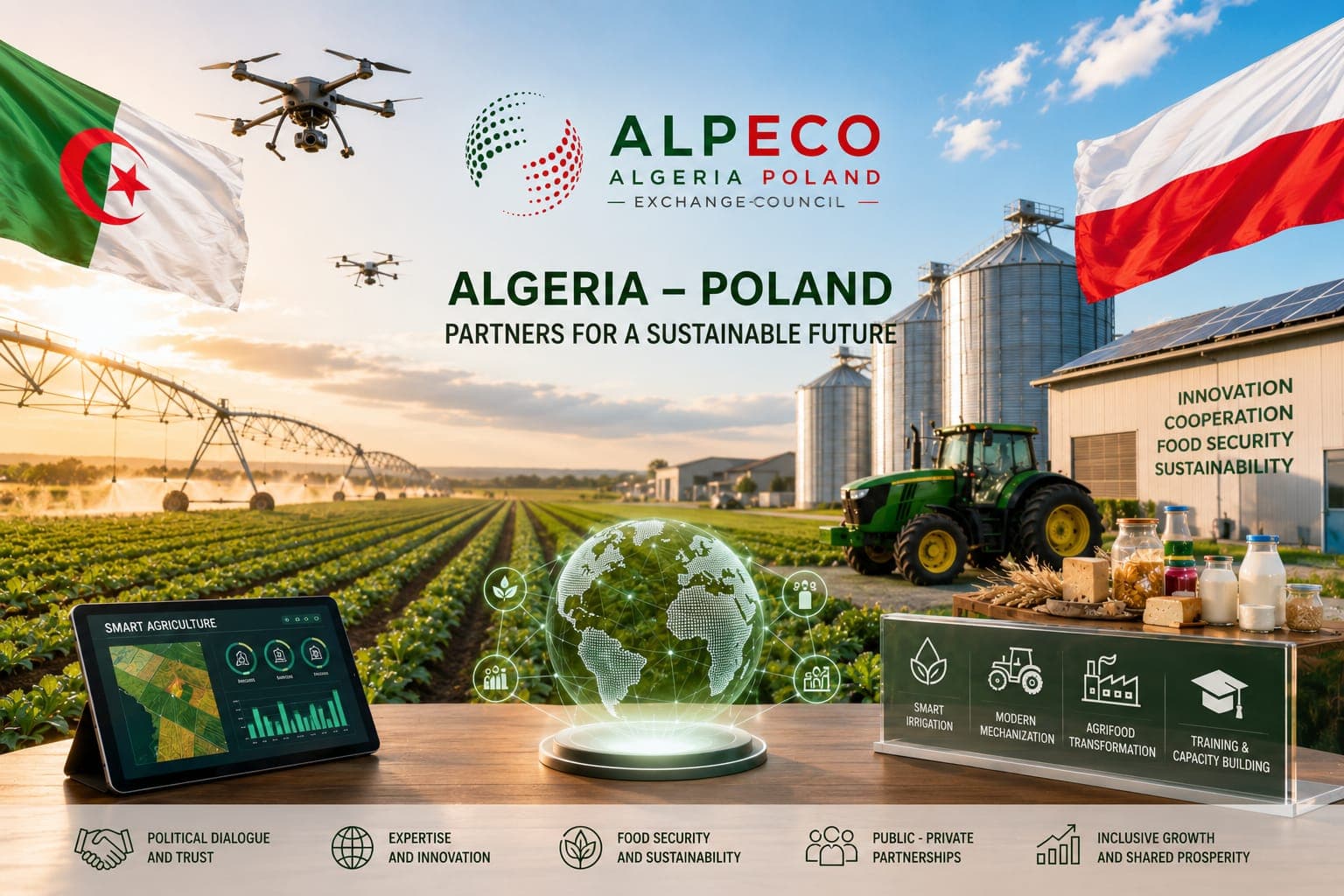
Algeria-Poland: Agricultural Innovation & Food Security
Food security has become one of the defining strategic priorities of the twenty-first century. As global agriculture faces increasing challenges—from climate change and water scarcity to supply chain disruptions and rapid population growth—the need for resilient, innovative, and sustainable international partnerships has never been greater. Within this global context, Algeria and Poland possess complementary strengths that create a unique opportunity for a long-term strategic partnership in agriculture, agri-food industries, scientific research, and technological innovation.
Agricultural Innovation and Food Security Cooperation: Where Algeria and Poland Can Work Together
Few issues sit closer to the top of Algeria's national agenda than food security. With a population of more than 45 million and growing, and with food imports representing one of the largest items on the country's import bill, the government has set ambitious targets for reducing dependence on foreign supplies, particularly for wheat, the staple behind bread, couscous, and pasta. At the same time, Poland is one of the European Union's largest agricultural producers and exporters, and home to a growing cluster of companies working on precision farming, mechanisation, and food processing technology. The overlap between Algeria's stated needs and Poland's areas of strength is significant, and largely untapped.
Algeria's Food Security Push: Ambition Meets Reality
Algeria's government has set a high bar for itself. In August 2024, President Tebboune announced the goal of ending durum wheat imports entirely by 2026, and by mid-2025 the Agriculture Ministry was describing the season's harvest as exceeding earlier presidential targets, with yields in key growing regions reported well above the levels assumed in the original 2023 projections. Alongside durum wheat, officials have pointed to progress in barley production and to early experiments with new crops, including roughly 21,000 hectares now dedicated to rapeseed for table oil, and a 100-hectare pilot programme for soybean cultivation.
Behind these headline targets sits a broader programme: more than 120,000 hectares allocated to domestic and foreign investors for cereal production, over 420,000 tonnes of certified seed distributed for the 2024/25 planting season across more than three million hectares, and a grain reserve system being expanded toward a national capacity of 6.4 million tonnes by 2026, supported by more than 350 collection centres and modernised port silos.
At the same time, independent analyses urge caution. Algeria has in recent years been among the world's largest per-capita wheat importers, with import volumes in the range of 7 to 9 million tonnes even during relatively good harvests, and the country remains, by some measures, Africa's second-largest food importer after Egypt. Climate vulnerability, particularly drought in the northern farming belt, is widely cited as the key constraint, with analysts arguing that durable progress toward self-sufficiency will depend on sustained investment in irrigation efficiency and water management, not only on planting more land.
Algeria's own 2026 budget appears to reflect this: a roughly 4 percent increase in agricultural spending has been earmarked specifically for irrigation efficiency, seed system improvements, rural mechanisation, and agri-food processing, the same set of priorities that, not coincidentally, align closely with areas where Polish companies have built up real expertise.
Where Polish Agri-Tech Fits
Poland's precision agriculture sector has developed specific strengths that map directly onto Algeria's stated priorities. Companies such as SatAgro use satellite-based monitoring to help farmers manage large areas more precisely, reducing waste of water and inputs, directly relevant to a country where irrigation efficiency has been identified as a priority area for investment. FieldBee, which specialises in GPS guidance systems for agricultural machinery and has based its hardware manufacturing in Poland, addresses the rural mechanisation priority identified in Algeria's agricultural budget. Polish agricultural machinery manufacturers, including companies such as Metal-Fach, bring decades of experience building equipment suited to the kind of large-scale arable farming Algeria is now expanding.
None of this requires Algeria to adopt unfamiliar or unproven technology. Precision agriculture and modern mechanisation are widely used across the EU, including in Poland's own cereal and oilseed sectors, sectors of direct relevance to Algeria's durum wheat, barley, rapeseed, and soybean ambitions.
Dairy and Food Processing: A Natural Overlap
Dairy is perhaps the clearest example of how the Algeria-Poland relationship could evolve from a trade relationship into a cooperation one. Skimmed milk powder has long been the single largest category of Polish agri-food exports to Algeria, reflecting Algeria's heavy reliance on imported milk powder to meet domestic consumption.
At the same time, Algeria is now pursuing one of the largest dairy development projects in Africa, a multi-billion-dollar integrated dairy operation in the Adrar region, aimed at eventually supplying up to half of the country's powdered milk needs domestically. As that kind of domestic dairy capacity comes online over the coming years, the nature of the opportunity for Polish companies is likely to shift, from exporting milk powder itself, toward supplying processing equipment, genetics and herd management expertise, veterinary services, and training for the workforce a large-scale dairy sector requires.
This shift is already visible in the composition of recent trade delegations: Poland's 2026 high-level visit to Algeria included a senior veterinary official, reflecting the role that animal health, certification, and herd management expertise plays alongside trade in live animals and animal products, particularly as Algeria's domestic livestock sector expands.
Climate-Smart Agriculture and Water Management
If there is a single theme that runs through both the optimistic and the more cautious assessments of Algeria's food security strategy, it is water. Drought-affected harvests, the limits of rain-fed agriculture in the northern farming belt, and the case for greater investment in desalination and efficient irrigation all point to the same conclusion: technology and expertise that helps farmers use water more efficiently is likely to remain in demand regardless of how quickly Algeria's broader self-sufficiency targets are met.
This is an area where European agricultural technology more broadly, and Polish precision agriculture specifically, given its focus on data-driven input management, has a natural role to play, not as a replacement for large infrastructure investments in irrigation and desalination, but as a complement that helps make existing water resources go further on the farms that depend on them.
A Cooperation Model, Not Just a Trade Relationship
Taken together, these areas point toward a model of cooperation that goes beyond conventional trade: joint research or pilot projects in precision agriculture, training programmes for Algerian technicians and farm managers in mechanisation and herd management, and academic exchange between agricultural faculties in both countries, building on existing institutional relationships between Algerian and Polish universities. This is consistent with the broader pattern seen in Algeria's other major foreign investment projects, where local training, technology transfer, and capacity-building have been central to how projects are structured and promoted.
For Poland, the upside is not limited to exports of equipment or services. A more food-secure, agriculturally modernised Algeria is also a market with greater purchasing power and a more sophisticated agri-food sector, one that, over time, could become a partner for joint ventures, processing investments, and even re-export opportunities across North Africa, rather than simply a destination for raw commodity exports.
Frequently Asked Questions
Is Algeria close to achieving food self-sufficiency in wheat?
The government has set 2026 as the target for ending durum wheat imports, citing a strong 2025 harvest, but independent analyses note that Algeria has historically been among the world's largest per-capita wheat importers and that climate vulnerability, especially drought, remains a significant constraint on sustained self-sufficiency.
What are Algeria's main agricultural priorities for 2026?
Algeria's 2026 agricultural budget increase has been directed toward irrigation efficiency, seed system improvements, rural mechanisation, and agri-food processing, alongside continued expansion of cereal cultivation and grain storage capacity.
How could the Algeria-Poland dairy relationship change over time?
As Algeria develops large-scale domestic dairy production, including a major integrated dairy project in the Adrar region, the opportunity for Polish companies may shift from exporting milk powder toward supplying processing equipment, genetics, veterinary expertise, and training.
What kind of Polish agri-tech is most relevant to Algeria's needs?
Precision agriculture tools such as satellite-based crop monitoring and GPS-guided machinery, along with modern agricultural equipment manufacturing, align closely with Algeria's stated priorities around irrigation efficiency and rural mechanisation.
Conclusion
Algeria's food security strategy is ambitious, and the honest picture is one of real progress alongside real structural challenges, particularly around water. What stands out is how closely Algeria's stated priorities for 2026, irrigation efficiency, mechanisation, seed systems, and agri-food processing, align with areas where Polish agriculture and Polish companies have genuine, demonstrated expertise. The opportunity is less about a single trade transaction and more about a sustained cooperation relationship: one that could help Algeria make progress on food security while giving Polish companies a foothold in a market that is investing heavily in exactly the capabilities they offer.
ALPECO Call to Action
Building the kind of pilot projects, training partnerships, and academic exchanges that this sort of cooperation depends on is an area where ALPECO (Algeria Poland Exchange Council) aims to play a connecting role, alongside the institutions and trade missions already engaged in Algeria-Poland agricultural relations.