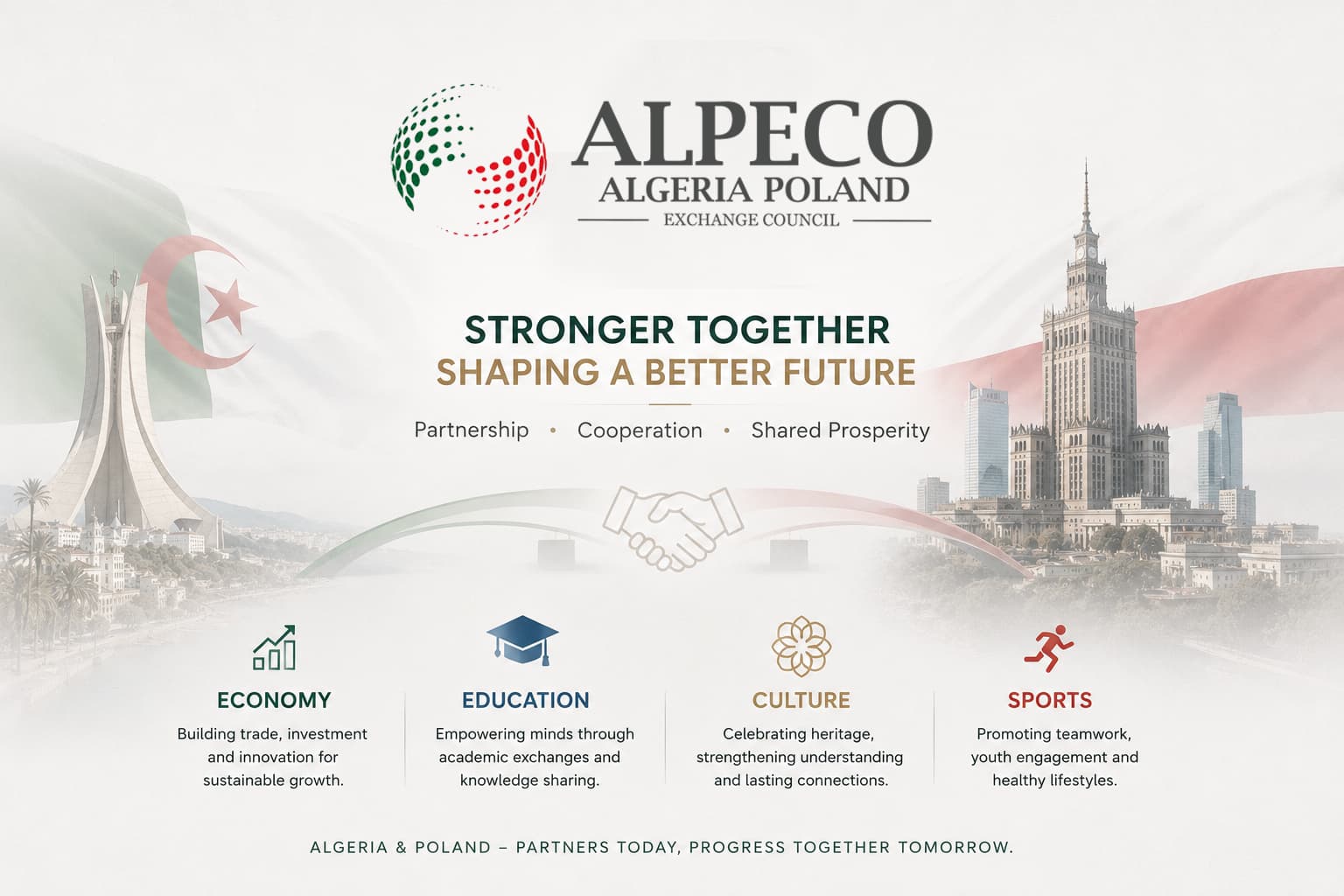
ALPECO – Bridging Nations, Building Future
In an increasingly interconnected world, bilateral cooperation is no longer a diplomatic luxury—it is an economic and social necessity. The Algeria–Poland Exchange Council (ALPECO) emerges as a forward-thinking platform designed to connect institutions, businesses, universities, and cultural organizations from both countries into a structured and sustainable collaboration ecosystem.
ALPECO is not simply an organization; it is a bridge of opportunity. Its mission is to transform Algeria–Poland relations into a practical framework of exchange, investment, innovation, and shared growth across four strategic pillars: economy, education, culture, and sport.
1. Economic Pillar – Unlocking Business and Investment Opportunities
For business owners and companies, ALPECO serves as a direct gateway to two complementary markets: North Africa and Central Europe.
Through curated business forums, trade missions, and B2B matchmaking sessions, companies gain:
Direct access to new export and import markets
Investment opportunities in high-growth sectors
Strategic partnerships with foreign companies
Market intelligence and regulatory insights in both regions
For startups and SMEs, ALPECO acts as a launchpad for internationalization, reducing barriers to entry and connecting them with investors, distributors, and institutional partners.
In essence, ALPECO transforms bilateral relations into real commercial value.
2. Education Pillar – Connecting Universities and Future Talent
For universities and academic institutions, ALPECO is a platform for global relevance and student mobility.
It encourages:
University-to-university partnerships
Joint research programs and innovation projects
Academic staff exchanges
Scholarship and student mobility programs (including Erasmus+ pathways)
Collaborative conferences and scientific forums
This pillar ensures that education becomes a shared ecosystem of knowledge, preparing students for international careers while strengthening institutional prestige and global rankings.
3. Cultural Pillar – Strengthening Identity Through Exchange
Cultural associations and creative industries find in ALPECO a powerful stage for expression and collaboration.
The cultural pillar promotes:
Cross-cultural festivals and exhibitions
Art, music, film, and heritage exchanges
Joint cultural heritage preservation projects
Intercultural dialogue initiatives
Promotion of tourism through cultural storytelling
By encouraging mutual understanding between Algerian and Polish societies, ALPECO helps build long-term soft power connections rooted in respect, diversity, and shared identity.
4. Sports Pillar – Building Unity Through Competition and Cooperation
Sport is one of the strongest universal languages, and ALPECO leverages it as a tool for diplomacy and youth engagement.
This pillar includes:
Cooperation between sports federations and clubs
Youth development and training programs
Friendly matches and tournaments
Sports science and coaching exchanges
Infrastructure development partnerships
Through sport, ALPECO promotes discipline, teamwork, and international friendship among young generations.
A Platform for Collective Growth
ALPECO brings together four key ecosystems—business, academia, culture, and sport—into a unified cooperation model. This integrated approach ensures that partnerships are not limited to conferences, but evolve into long-term institutional and commercial relationships.
For companies, it means expansion.
For universities, it means global relevance.
For cultural associations, it means visibility and preservation.
For sports institutions, it means development and international cooperation.
Conclusion
The Algeria–Poland Exchange Council (ALPECO) represents a new generation of international cooperation platforms—practical, structured, and impact-driven. By connecting stakeholders across four essential pillars, it builds not only partnerships but a shared future between two dynamic nations.
In a world defined by collaboration, ALPECO stands as a catalyst for opportunity—where ideas become projects, and partnerships become long-term success stories.