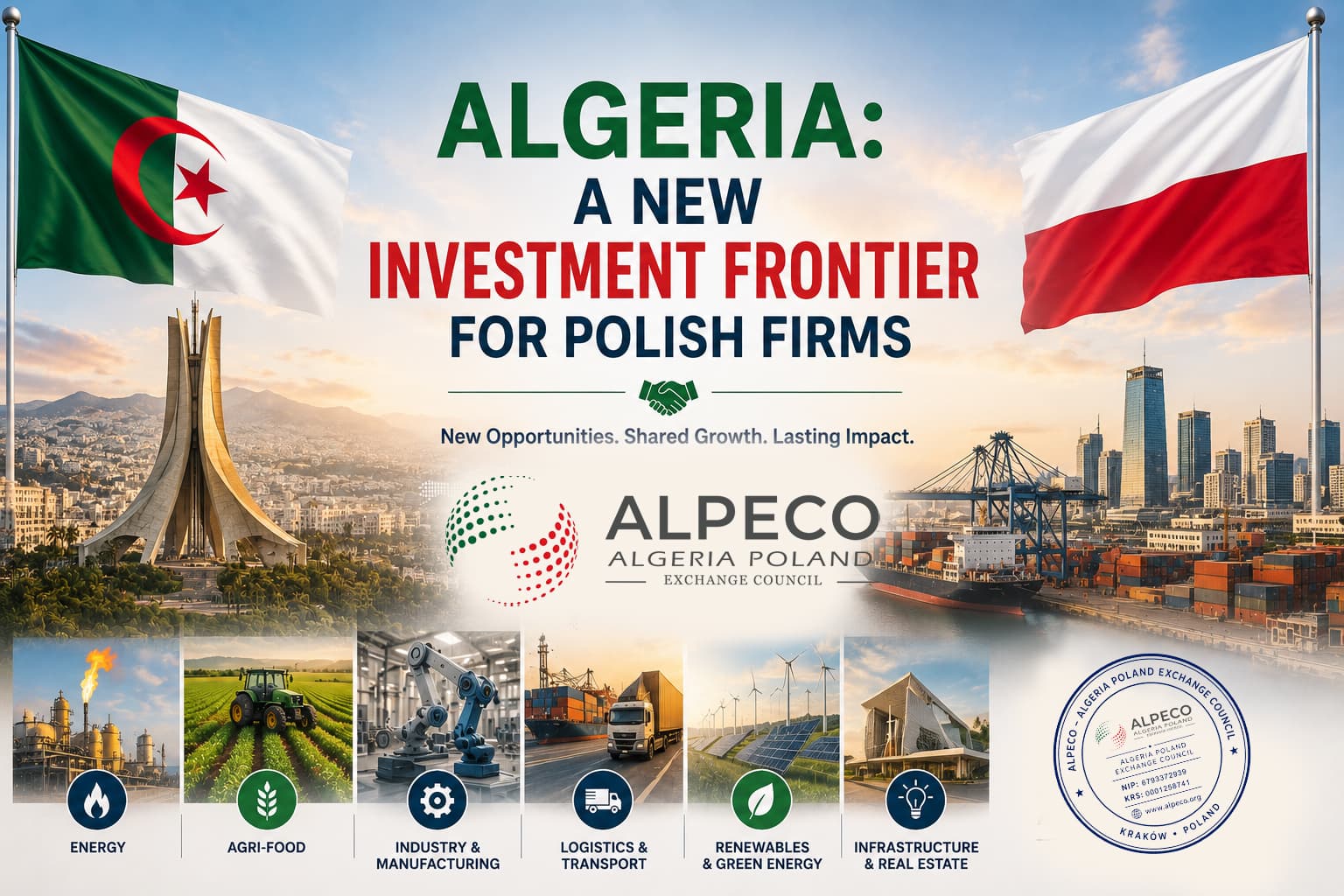
Algeria: A New Investment Frontier for Polish Firms
Algeria is rapidly emerging as one of North Africa’s most promising investment destinations. With abundant natural resources, ambitious economic reforms, strategic access to African markets, and expanding opportunities across energy, agriculture, manufacturing, logistics, and renewable technologies, the country offers Polish companies a unique platform for growth and long-term partnerships. Through ALPECO, businesses from both nations can build bridges, unlock new opportunities, and shape a future of shared prosperity.
Algeria: An Open Door for Polish Investment
Algeria, a country of around 45 million people and Africa's third-largest economy, is in the middle of one of the most significant economic reform pushes in its recent history. Successive changes to its investment framework, culminating in the 2022 Investment Law and reinforced by the 2026 Finance Law, have removed long-standing barriers to foreign ownership, simplified registration procedures, and introduced a structured set of fiscal incentives. For Polish companies looking to diversify beyond saturated EU markets, Algeria now represents a market that is both large and, for the moment, largely untapped by Polish capital.
This article looks at what has changed in Algeria's investment climate, where the most promising sectors lie for Polish businesses, and why early movers may have a meaningful advantage.
A Reformed Legal Framework Designed to Attract Foreign Capital
For years, foreign investors in Algeria operated under the so-called “51/49 rule,” which required majority Algerian ownership of any new venture. Reforms beginning in 2020 narrowed this requirement to a short list of strategic sectors, hydrocarbons, mining, defence, and pharmaceutical manufacturing, and the 2022 Investment Law (Law 22-18) went further, establishing a more liberal default position for most other sectors and removing the blanket ownership cap.
The reforms also created the Agence Algérienne de Promotion de l'Investissement (AAPI) as a single window for registering investment projects, replacing the previous agency and aiming to reduce the bureaucratic friction that has historically discouraged foreign entrants.
On the incentives side, the new framework organises benefits into three clear schemes, common, additional, and exceptional, depending on the size, location, and strategic priority of a project. Investors who register through AAPI can typically access:
• Exemption from customs duties on imported equipment and production inputs related to the investment
• Exemption from VAT on imported goods and services that go directly into the investment project
• Multi-year exemptions from real estate and property taxes (commonly cited at around 10 years)
• Significantly reduced fees on land and premises during the construction phase
The 2026 Finance Law, in effect since January 2026, layered further adjustments onto this framework, including changes to withholding tax rates and clearer rules on permanent establishment for foreign companies. Taken together, these changes mean that, for the first time in years, the regulatory starting point for a foreign investor in most sectors is full ownership, a registered incentive package, and a single administrative point of contact, rather than a negotiated exception.
Where the Opportunities Are
Agri-food processing and agricultural machinery
Algeria imports a large share of its food and agricultural inputs, including the skimmed milk powder, cereals, and other products that already form the core of Poland's agri-food exports to the country. The next step for many of these supply relationships is local processing and assembly, dairy reconstitution plants, animal feed production, and agricultural equipment, where the government has actively encouraged joint ventures. A Finnish-Algerian joint venture producing tractors and agricultural machinery in Sidi Bel Abbès is one example of this model already operating successfully. Poland's agricultural machinery and food processing equipment manufacturers are well placed to explore similar partnerships.
Construction, building materials, and housing
Algeria continues to face a significant housing shortage, and construction was one of the sectors that attracted notable foreign direct investment in recent years, alongside extractive industries and manufacturing, according to Bank of Algeria data for 2023. For Polish companies in construction materials, prefabricated housing, windows and joinery, insulation, and related building products, sectors where Poland has strong export industries, this represents a market with structural, long-term demand.
Pharmaceuticals and healthcare
Algeria's government has repeatedly identified pharmaceuticals as a priority sector for import substitution, and healthcare more broadly is flagged as an area of significant need. Pharmaceutical manufacturing remains one of the sectors where majority Algerian ownership is still required, but this has not prevented international pharmaceutical companies from establishing local manufacturing partnerships. Poland is home to major pharmaceutical manufacturers with established export operations, making this a sector worth exploring through joint ventures and licensing arrangements.
Renewable energy
Renewable energy is consistently listed among Algeria's priority investment sectors, supported by dedicated incentive schemes for qualifying projects. With Poland's own renewable energy sector having grown rapidly over the past decade, particularly in solar and wind, Polish developers, equipment suppliers, and engineering firms bring directly relevant experience to a market that is still in the early stages of diversifying its energy mix.
Manufacturing and import substitution more broadly
Algeria imports the large majority of its manufactured goods, a structural gap the government has explicitly identified as a priority to close. For Polish manufacturers in sectors ranging from furniture and packaging to electrical equipment and plastics, all categories already present in Polish exports to Algeria, establishing local production or assembly could mean lower costs, preferential treatment under the new investment law, and direct access to a market of 45 million consumers as well as potential re-export opportunities across North Africa.
A Market With Limited Polish Presence: The First-Mover Advantage
According to data from AAPI, the largest sources of foreign investment stock in Algeria by country are the United States (around 29 percent), followed by Italy and France (around 10 percent each), Spain (around 7 percent), and the United Kingdom (around 6 percent). Poland does not currently appear among the leading investor countries in Algeria.
This is worth pausing on. Poland has a growing track record of outward investment, with companies such as Orlen, KGHM, Asseco, and Polpharma expanding into new markets in recent years, and Polish agri-food exports to Algeria have grown by double digits. Yet Polish direct investment in Algeria remains marginal compared to other European economies of similar size. For companies willing to do the groundwork now, this gap represents an opportunity to establish a position in a large, reforming market well ahead of broader Polish corporate interest catching up.
Getting Started: What Polish Companies Need to Know
• Registration through AAPI is the starting point for accessing incentive schemes and should be initiated early in project planning
• Confirm whether your sector falls under the remaining ownership restrictions (hydrocarbons, mining, defence, pharmaceutical manufacturing) before structuring a deal
• Engage qualified local legal and tax counsel from the outset, particularly given the additional compliance requirements introduced by the 2026 Finance Law
• Consider joint ventures with established local partners, a model used successfully across agriculture, manufacturing, and energy
• Build relationships through trade missions, business forums, and organisations already active in the Algeria-Poland corridor
Frequently Asked Questions
Can Polish companies own 100% of a business in Algeria?
For most sectors, yes. Reforms since 2020 and the 2022 Investment Law removed the previous blanket requirement for majority Algerian ownership, except in hydrocarbons, mining, defence, and pharmaceutical manufacturing, which remain subject to specific rules.
What incentives are available to foreign investors?
Investors registering through AAPI can generally access exemptions from customs duties and VAT on imported equipment and inputs related to their project, multi-year exemptions from real estate taxes, and reduced fees on land and premises during construction, with additional or exceptional incentives available for priority projects.
Which sectors are most promising for Polish companies?
Agri-food processing and agricultural machinery, construction materials and housing, pharmaceuticals and healthcare, renewable energy, and broader manufacturing for import substitution all stand out, given Algeria's stated priorities and existing trade flows with Poland.
Is now a good time to enter the Algerian market?
The combination of a more liberal ownership regime, a single-window registration agency, structured incentives, and very limited existing Polish investment suggests a window in which early movers can establish themselves before competition from other Polish companies increases.
Conclusion
Algeria's investment reforms represent a genuine shift in how the country approaches foreign capital, moving from a restrictive, case-by-case system toward a more predictable framework built around full ownership in most sectors, a single registration agency, and clearly defined incentives. Combined with Algeria's existing trade relationship with Poland, particularly in agri-food, and its substantial unmet demand in construction, manufacturing, pharmaceuticals, and energy, the conditions for Polish companies to enter this market are more favourable than at any point in recent years. The companies that act early, with the right local partnerships and guidance, stand to benefit most.
ALPECO Call to Action
ALPECO (Algeria Poland Exchange Council) exists to help Polish companies navigate exactly this kind of opportunity, through market information, introductions to Algerian partners and institutions, and participation in upcoming Algeria-Poland business events. If your organization is considering investment or partnership opportunities in Algeria, or would like to support ALPECO's work connecting Polish and Algerian businesses as a sponsor or partner, get in touch to learn more about how we can work together.