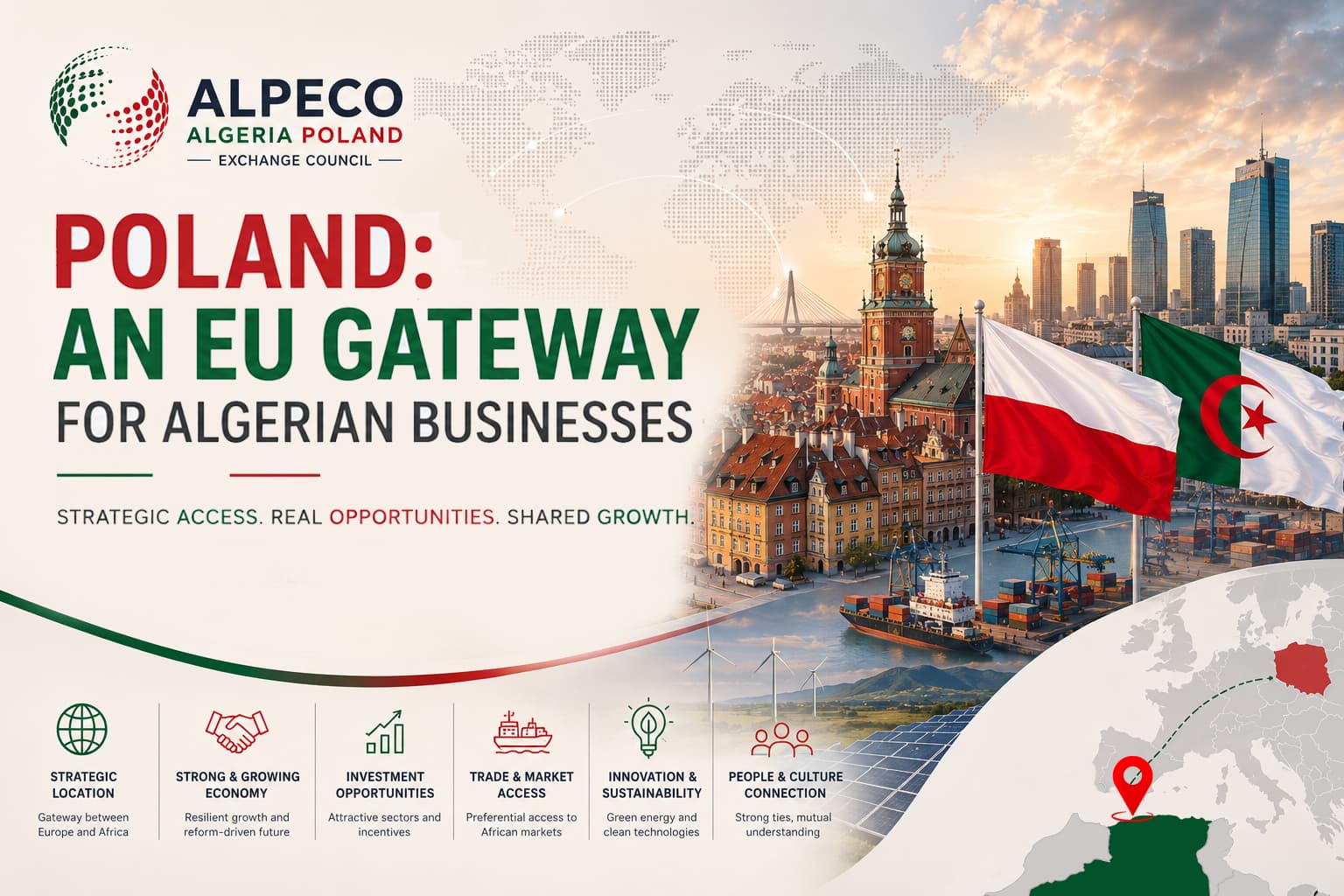
Poland a Strategic Gateway to the EU for Algerian Businesses
Algerian companies already have preferential EU market access. Here's why Poland's location, costs, and incentives make it a strong entry point. For Algerian companies looking to expand into the European Union, one of the first questions is rarely whether the EU market is accessible, it is where within the EU to establish a foothold.
Why Poland Is a Strategic Gateway to the European Union for Algerian Businesses
Algeria already has a trade agreement with the EU that gives many of its exports preferential treatment. The more practical challenge is logistics, cost, and finding a base from which to reach the EU's 450 million consumers efficiently. On each of these points, Poland has a strong case to make.
Preferential Access to the EU Market Already Exists
The EU-Algeria Association Agreement, signed in 2002 and in force since 2005, established a framework for liberalised trade in goods between the two parties, with terms that include elements of asymmetry in Algeria's favour. The agreement targeted the complete dismantling of tariffs on industrial goods by September 2020, a target that has largely been met. As a result, the EU remains Algeria's largest trading partner, accounting for close to half of Algeria's international trade in 2024.
This matters because it means the legal pathway for many Algerian products to enter the EU duty-free already exists. The strategic question for Algerian exporters is therefore not primarily about market access in principle, but about which EU country offers the best combination of cost, location, and logistics infrastructure to make that access work in practice. This is where Poland's position becomes relevant.
Poland's Position as a Central European Logistics Hub
Poland sits at the crossroads of major European trade routes, with direct access to the Baltic Sea and a long border with Germany, the EU's largest economy. Industry analysts have repeatedly described Poland as a natural distribution base for companies seeking to serve both Western and Central European markets from a single location.
On cost, Poland remains highly competitive. Industry reports note that logistics and warehouse rents in Poland are typically 30-40 percent lower than in Germany or France, and 15-20 percent lower than in the Czech Republic, while still offering modern, well-connected facilities. The Port of Gdańsk has been highlighted as one of Europe's fastest-growing ports, providing maritime access that complements Poland's road and rail networks.
This combination, central geography, lower operating costs, and growing infrastructure, has made Poland one of the most active logistics and distribution markets in Europe, with strong demand for warehouse space in locations such as Warsaw, Wrocław, and the Gdańsk-Gdynia area.
A Substantial Market in Its Own Right
Poland is not simply a transit country. With a population of roughly 38 million and one of the more resilient economies in the EU in recent years, outpacing the eurozone average in GDP growth, Poland represents a significant consumer market on its own. A growing middle class and rising domestic consumption mean that products entering the EU via Poland can also find demand within the Polish market itself, before being distributed further afield.
Poland has also developed a strong manufacturing base across sectors such as automotive components, machinery, furniture, food processing, and electronics, creating potential for Algerian companies not only to distribute finished goods through Poland, but also to explore manufacturing partnerships, supply relationships, or co-production arrangements with Polish firms.
Investment Incentives for Setting Up in Poland
Poland operates a system of Special Economic Zones (SEZs) and, increasingly, the broader Polish Investment Zone, which offer corporate income tax exemptions to qualifying investors based on the scale of investment and the number of jobs created. As of the current framework, Poland has 14 SEZs, with this system being progressively integrated into the nationwide Polish Investment Zone.
On the practical side, setting up a company in Poland is relatively straightforward. The most common vehicle for foreign-owned businesses is the limited liability company (Sp. z o.o.), which has a low minimum share capital requirement and can typically be registered without excessive bureaucratic delay. Poland's workforce is also frequently cited as a competitive advantage, with strong skills in engineering, IT, and logistics, and a high level of English proficiency among professionals.
What This Means for Algerian Exporters and Investors
Taken together, these factors suggest a practical pathway for Algerian businesses: products and services that already benefit from preferential access under the EU-Algeria Association Agreement can be channelled into the EU through a Polish base, taking advantage of competitive logistics costs, a central location relative to both Western Europe and the growing markets of Central and Eastern Europe, and a stable, transparent regulatory environment aligned with EU rules.
For Algerian companies in sectors such as agri-food, textiles, chemicals, and light manufacturing, all areas where Algeria has existing or developing export capacity, Poland offers an entry point that combines EU market access with costs and logistics that are difficult to match in Western Europe.
Frequently Asked Questions
Do Algerian products already have preferential access to the EU market?
Yes. Under the EU-Algeria Association Agreement, in force since 2005, most industrial goods from Algeria benefit from duty-free access to the EU, as part of a broader framework liberalising trade between the two parties.
Why choose Poland over Western European countries as an entry point?
Poland offers a central European location with access to both Western and Central/Eastern European markets, logistics and warehouse costs that are significantly lower than in Germany or France, and a system of tax incentives for qualifying investments through Special Economic Zones and the Polish Investment Zone.
Is it difficult for a foreign company to set up in Poland?
Setting up a limited liability company (Sp. z o.o.) in Poland is relatively straightforward, with a low minimum capital requirement and registration processes that are generally faster and less bureaucratic than in many other EU markets.
What sectors offer the most potential for Algerian companies entering via Poland?
Agri-food, textiles, chemicals, and light manufacturing are sectors where Algeria has existing or developing export capacity and where Poland's logistics infrastructure and manufacturing base offer natural complementarities.
Conclusion
For Algerian businesses, the question of EU market access has, in many respects, already been answered by the EU-Algeria Association Agreement. What remains is a question of strategy: where to base operations, how to manage logistics costs, and how to access incentives that make EU expansion financially viable. Poland's combination of central location, competitive costs, investment incentives, and a substantial domestic market makes it one of the strongest candidates for Algerian companies to consider as they plan their European expansion.
ALPECO Call to Action
ALPECO (Algeria Poland Exchange Council) works to connect Algerian businesses with the partners, institutions, and information they need to explore the Polish and broader EU market. Whether you are an Algerian company exploring export or investment opportunities in Poland, or a Polish organization interested in supporting this work as a sponsor or partner, get in touch with ALPECO to learn more about upcoming events and partnership opportunities.